Crafting Effective Requests
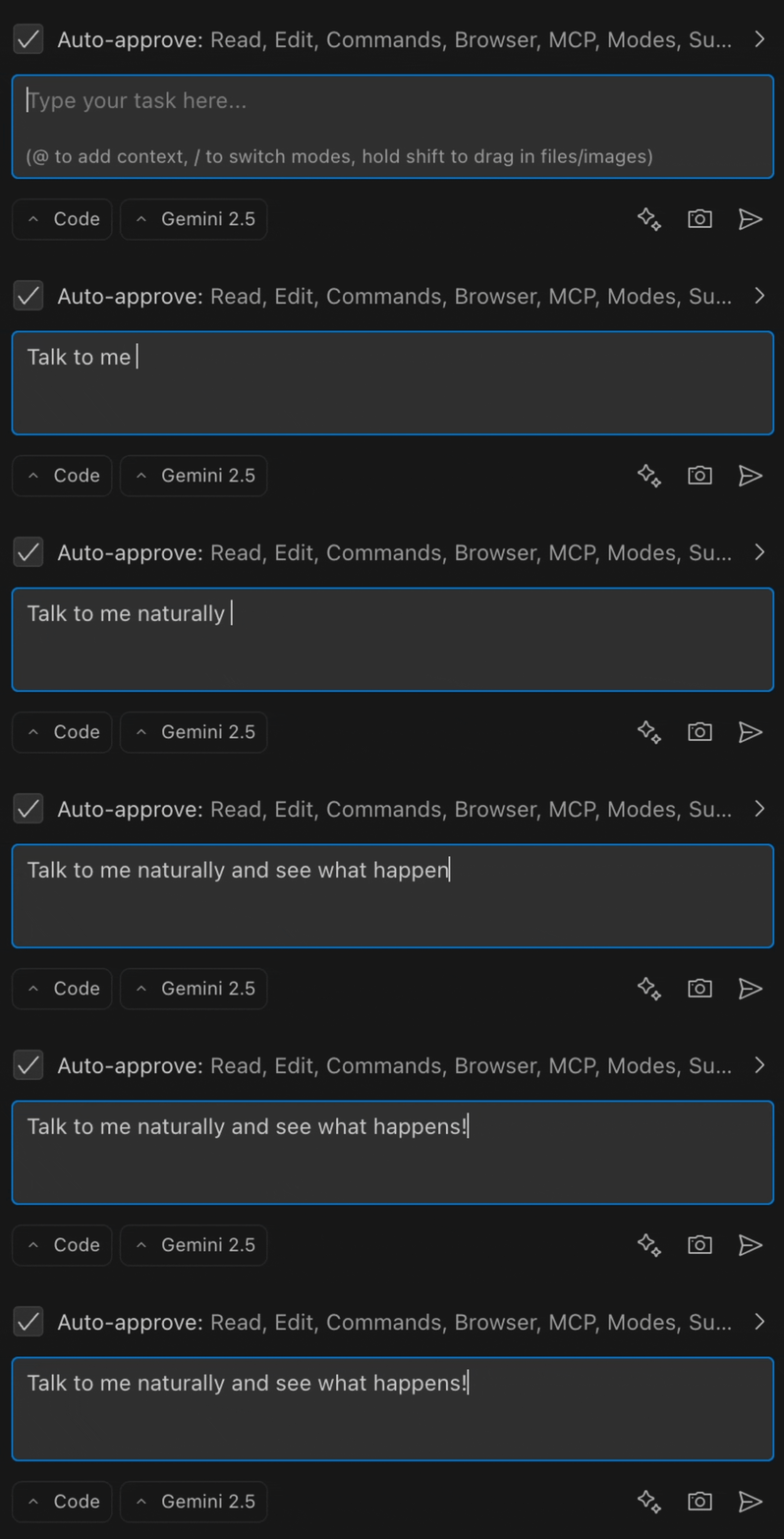
Thunderflow AI is engineered to understand natural language communication. There's no need for specialized commands or syntax—simply express your needs in plain English, just as you would when collaborating with a human developer.
Strategies for Optimal Communication
When formulating your requests, clarity and precision significantly enhance Thunderflow AI's ability to deliver exactly what you need.
| Strategy | Implementation |
|---|---|
| Be specific and precise | "Fix the bug in calculateTotal that returns incorrect results when processing negative values" instead of "Fix the code" |
| Provide relevant context | Utilize @ Context Mentions to reference specific files and code segments |
| Structure complex tasks | Divide sophisticated requirements into smaller, more manageable sequential steps |
| Illustrate with examples | Include sample code snippets when you require particular formatting or coding style |
Request Examples
create a new file named `utils.py` and add a function called `add` that takes two numbers as arguments and returns their sum
in the file @src/components/Button.tsx, change the color of the button to blue
find all instances of the variable `oldValue` in @/src/App.js and replace them with `newValue`
run the command `npm install` in the terminal
explain the function `calculateTotal` in @/src/utils.ts
@problems address all detected problems
Communication Practices to Avoid
| DON'T | DO |
|---|---|
| Submit vague or ambiguous requests | Clearly specify exactly what needs to be accomplished |
| Assume Thunderflow AI understands implicit context | Explicitly reference relevant files, functions, and requirements |
| Use excessive technical jargon or abbreviations | Communicate with clear, straightforward language |
| Combine multiple unrelated tasks in one request | Focus each submission on a single, coherent objective |
| Proceed without verifying generated solutions | Review the code to ensure it meets all requirements before moving forward |